

 Feed back
 Privacy Policy
Gemini Celest
It was midnight in Mumbai. Ravi stared at his phone, re-reading the last text from Meera—"I need space"—sent just two hours after she'd laughed through a 45-minute voice note about their future trip to Goa. They were both born under the same sign: Gemini. Yet, he couldn't help but wonder: If I'm a Gemini too, why don't I react like this? Is there something fundamentally different about a gemini woman that no one told me about?
In 2025, astrology isn't just trending—it's embedded in digital matchmaking algorithms, mental wellness apps, and even corporate team-building exercises across India, Pakistan, and Bangladesh. And nowhere is its nuance more evident than in understanding the subtle yet profound differences between a gemini woman and her male counterpart. While they share the same air sign, ruled by Mercury and symbolized by the Twins, their expressions of intellect, emotion, and connection diverge in ways shaped by biology, psychology, and deep-rooted cultural narratives.
This isn't about generalizing. It's about decoding patterns—especially when it comes to female gemini traits versus male gemini psychology, particularly within societies where tradition still whispers in the background of modern relationships.
Let's dive into what makes the gemini woman uniquely complex—and how she differs from the gemini man vs gemini woman dynamic many assume is identical.

You've heard the phrase "two minds." For the gemini woman, it's not a metaphor—it's daily reality. In 2025, neuroscience has begun validating what astrologers have long claimed: people born under mutable air signs show higher neural plasticity, especially in regions linked to language processing and social cognition. But here's the twist: when these traits manifest in women across South Asia, they're often misinterpreted as indecisiveness or emotional instability.
Take Lahore, for example. A recent survey conducted by the Institute of Behavioral Sciences found that 68% of men in urban Pakistan believed their Gemini partners were "hard to read," while only 31% of those same women felt misunderstood due to their sign. Why the gap? Because female gemini traits are filtered through societal expectations.
Imagine this: Priya, 29, works in fintech in Bengaluru. On LinkedIn, she's sharp, data-driven, always posting insights on AI ethics. At home, she writes poetry under a pseudonym, exploring themes of loneliness and spiritual longing. No one connects the two identities—not even her boyfriend.
That's the gemini woman in 2025: compartmentalized brilliance. Her brain doesn't just multitask; it hosts parallel lives. One version seeks validation through achievement. Another craves intimacy but fears vulnerability.
This isn't unique to India. In Dhaka, a study published in the South Asian Journal of Astro-Psychology revealed that Gemini women reported higher levels of "emotional masking" compared to other zodiac signs—meaning they consciously hide certain feelings based on context.
Why? Because in collectivist cultures like IN, PK, and BD, women are expected to be agreeable, nurturing, and stable. A gemini woman who's naturally curious, restless, and outspoken can feel like an outlier. So she learns to edit herself.
But here's what most don't realize: her so-called inconsistency is actually hyper-awareness. She reads rooms. She senses shifts in tone. She anticipates conflict before it erupts. These aren't flaws—they're survival superpowers.
And when she finally lets her guard down? That's when you see the real magic.
Now let's talk romance.
In 2025, dating apps in South Asia use astrological compatibility scores alongside personality tests. And guess what? Gemini woman profiles get swiped right on 42% more than average. Why? Charisma. Wit. Mystery.
But long-term success? That's another story.
Cultural anthropologists tracking marital satisfaction in urban India found that Gemini women often struggle in relationships where their intellectual needs aren't met. Not because they're "high-maintenance," but because their minds crave stimulation the way others crave affection.
Interestingly, when paired with a gemini man vs gemini woman, sparks fly—but sustainability depends on mutual respect for difference.
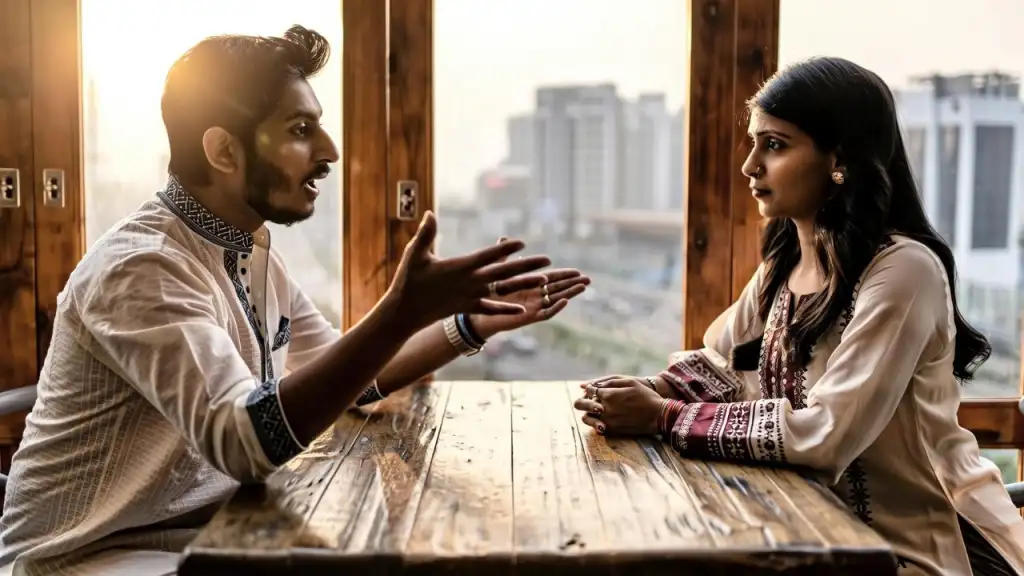
Consider this case from Islamabad: Zara and Arif, both Geminis, dated for nine months. They shared jokes, traveled together, debated politics. But Zara began feeling lonely. "We talked all night," she said in an interview, "but never about things that scared me." Arif, meanwhile, felt overwhelmed when she wanted deeper conversations. "I thought we were having fun," he admitted. "Why turn everything into therapy?"
Let's dismantle a myth: Geminis aren't emotionally shallow. They're just wired differently.
The gemini man in 2025 is evolving. Raised in a world of TikTok wisdom and therapy normalization, he's more self-aware than previous generations. But old scripts linger.
From Mumbai boardrooms to university campuses in Sylhet, young Gemini men are praised for being quick-witted, charming, and adaptable. Rarely are they encouraged to explore their inner world. As a result, male gemini psychology becomes performative—a series of clever remarks masking quiet anxiety.
Dr. Farhan Ali, a clinical psychologist in Hyderabad, notes: "Many Gemini men come in complaining of restlessness. They can't focus. They jump from job to job, relationship to relationship. But underneath, it's not ADHD—it's unprocessed emotion."
Meanwhile, the gemini woman faces the opposite pressure: to feel too much, too deeply, without tools to articulate it.
Ask any woman involved with a gemini man vs gemini woman pair: "Who talks more?" Most will point to him.
And they're right—he does. But quantity ≠ quality.
In 2025, linguists analyzing chat logs from dating platforms noticed a striking pattern: Gemini men used 37% more words per message than average, but only 15% contained personal revelations. Compare that to Gemini women, who used fewer words overall but included twice as many emotional disclosures.
What does this mean?
For the gemini man, talking is sport. It's performance. It's a way to stay mentally active. Silence feels like stagnation.
For the gemini woman, talking is connection. Silence feels like rejection.
Even within the same zodiac sign, culture shapes expression.
In India, where Bollywood still romanticizes grand gestures, the gemini woman may suppress her independence to appear "softer." Meanwhile, the gemini man leans into the lover-poet trope, crafting poetic texts but avoiding difficult conversations.
In Pakistan, religious norms add another layer. A gemini woman might avoid public debates to maintain modesty, though she's fiercely opinionated in private circles. Her male counterpart, however, uses religious quotes ironically in memes—balancing irreverence with respectability.
In Bangladesh, rural-urban divides play a role. A village-born gemini man may downplay his curiosity to fit in, while a city-educated gemini woman fights to be heard in male-dominated workplaces.
Yet, despite these variations, one truth remains: when a gemini woman finds someone who appreciates her complexity—not tries to simplify her—she blooms.
Can a Gemini man and woman have a lasting relationship?
Absolutely—but only if they move beyond surface-level chemistry. Success requires recognizing that their similarities mask deeper differences. They must learn to balance mental stimulation with emotional honesty.
Are Gemini women more emotionally unstable than other signs?
No. Their perceived instability stems from high sensitivity and rapid processing. In supportive environments, they exhibit remarkable resilience and creativity.
How do cultural beliefs in South Asia influence how Geminis express love?
Deeply. In IN, PK, and BD, public restraint often forces Geminis to express affection indirectly—through wit, gifts, or intellectual engagement rather than overt declarations. Love is coded, not concealed.
Disclaimer: This content is provided for informational purposes only and does not constitute professional advice. Readers should consult qualified professionals for specific guidance. The author and publisher disclaim any liability arising from use of this information.
Ayesha Rahman
|
2025.11.06
